Common DIY Carpet Cleaning Mistakes That Make Stains Worse
Many carpet problems do not start with the original spill. They become worse because of how the spill is handled afterward. Most homeowners act quickly, which is correct in principle, but the method used often creates conditions that make stain removal more difficult or even impossible.
The issue is not effort. It is misunderstanding how carpet, moisture, and chemistry interact.
One of the most common mistakes is excessive water use.
When a spill occurs, the instinct is to flush the area with water. The assumption is that more liquid will dilute and remove the contamination. In reality, adding too much water without proper extraction pushes the stain deeper into the carpet.
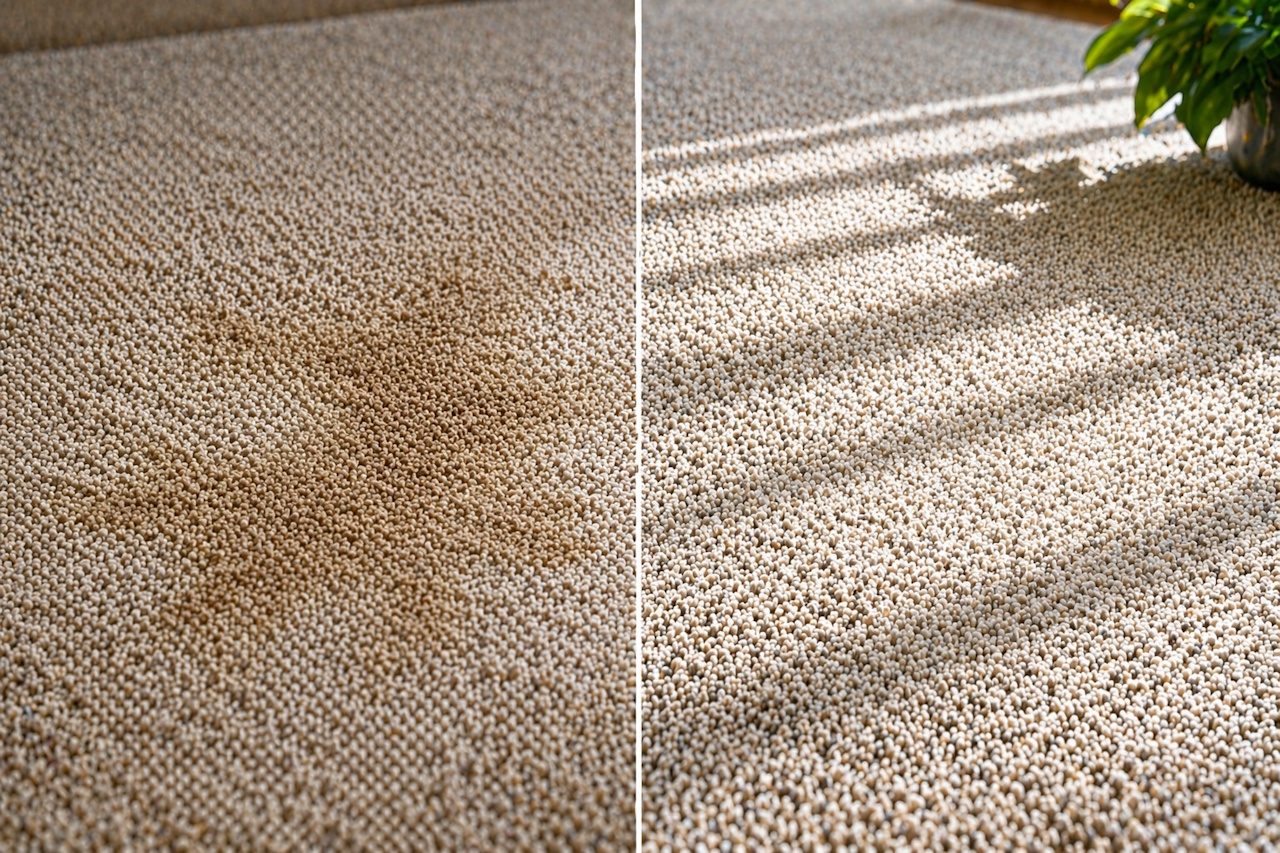
Carpet acts like a layered system. Liquid does not remain at the surface. It travels through fibres and into the backing and underlay. Without strong extraction, that moisture remains trapped below. Over time, it moves back upward as the carpet dries, carrying dissolved residue with it. This leads to recurring spots that appear after the area seemed clean.
Another common mistake is aggressive scrubbing.
Scrubbing feels productive, but it often causes mechanical damage. Carpet fibres can fray, lose their uniform direction, and reflect light unevenly. This creates visible distortion that remains even after the stain itself is removed.
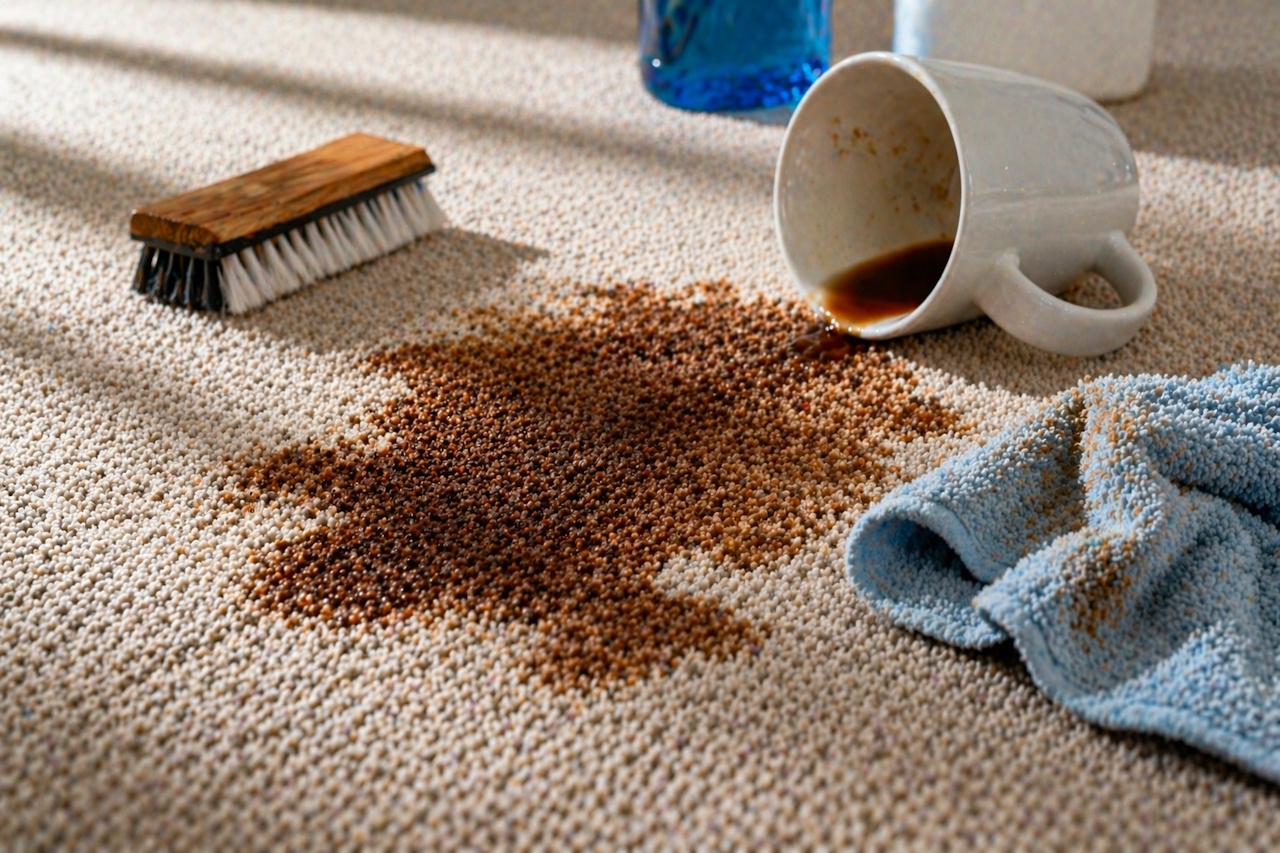
Scrubbing also spreads contamination outward. Instead of isolating the stain, it enlarges the affected area. What started as a small spot becomes a wider patch that is harder to treat evenly.
The correct approach is controlled blotting, not forceful friction.
Using the wrong cleaning product is another frequent issue.
Household cleaners are not designed for all carpet types or all stain categories. A product that works on kitchen surfaces may leave residue in carpet. That residue can attract soil, making the area look dirty again shortly after cleaning.
Some products are also too aggressive. High alkalinity or strong solvents can damage fibres, affect colour, or interact negatively with previous treatments. This is especially risky on wool or delicate synthetic blends.
Another problem is mixing multiple cleaning products.
When initial attempts do not work, it is common to try a second or third product without removing the first. This can create unpredictable chemical interactions. Residue builds up, and the carpet becomes harder to rinse effectively. In some cases, the mixture itself causes discolouration or fibre damage.
Heat misuse is another factor.
Hot water is often assumed to be universally helpful. While heat can assist in breaking down certain types of soil, it can also set others. Protein-based stains, such as blood or dairy, can become more difficult to remove when exposed to high temperature too early. Heat can also accelerate the bonding of dyes to fibres, making colour stains more permanent.
Without identifying the type of stain first, applying heat becomes a risk rather than a solution.
Over-application of cleaning solution is another common mistake.
More product does not mean better cleaning. Excess solution can remain in the carpet if it is not fully rinsed and extracted. This leaves behind a sticky residue that attracts dirt over time. The result is a carpet that looks clean immediately after treatment but becomes dull and dirty faster than before.
In many cases, the visible problem shifts from a stain to general soiling caused by leftover residue.
Insufficient rinsing is closely related.
Breaking down a stain is only part of the process. The dissolved material must be removed. Without proper rinsing and extraction, the residue stays in the carpet. This leads to recurring marks, texture changes, or odour.
Another overlooked mistake is ignoring fibre type.
Different carpets react differently to the same treatment. A method that works on a durable synthetic carpet may damage wool or lead to colour loss in certain fibres. Without knowing the material, it is easy to apply a process that is either ineffective or harmful.
Drying is also often neglected.
After cleaning, the carpet needs to dry efficiently. If moisture remains for too long, it can lead to odour, microbial growth, or backing issues. Poor airflow, excessive water use, or thick carpet construction can slow drying and increase the risk of these problems.
In some cases, the cleaning process itself introduces a new issue that was not present before.
Another pattern is repeated partial cleaning.
When a stain does not fully disappear, it is common to treat the same area multiple times. Each attempt adds more moisture and more product. Without proper extraction, this compounds the problem. The affected zone grows, and the concentration of residue increases.
Eventually, what started as a simple spill becomes a complex contamination issue involving multiple layers of the carpet.
There is also a misunderstanding between stain removal and damage.
Not every mark is removable. Some are the result of colour loss, chemical reaction, or fibre distortion. Continued attempts to clean these areas can worsen the appearance instead of improving it. Recognizing the difference between a removable stain and permanent change is important to avoid unnecessary damage.
Professional cleaning is not defined only by equipment, but by process.
Identification of the stain, selection of appropriate chemistry, controlled application, proper agitation, and complete extraction are all required to achieve a stable result. Skipping any of these steps reduces effectiveness and increases the likelihood of recurring issues.
The key reason DIY attempts fail is not lack of effort, but lack of balance.
Too much water, too much product, too much agitation, or the wrong combination of these factors leads to instability in the carpet. The goal is not to overwhelm the stain, but to break it down and remove it in a controlled way.
When that balance is missing, the carpet may look improved temporarily, but the underlying problem remains.
Most persistent carpet issues are not caused by the original spill alone. They are the result of how that spill was treated. Understanding these common mistakes is what prevents a small problem from becoming a permanent one.